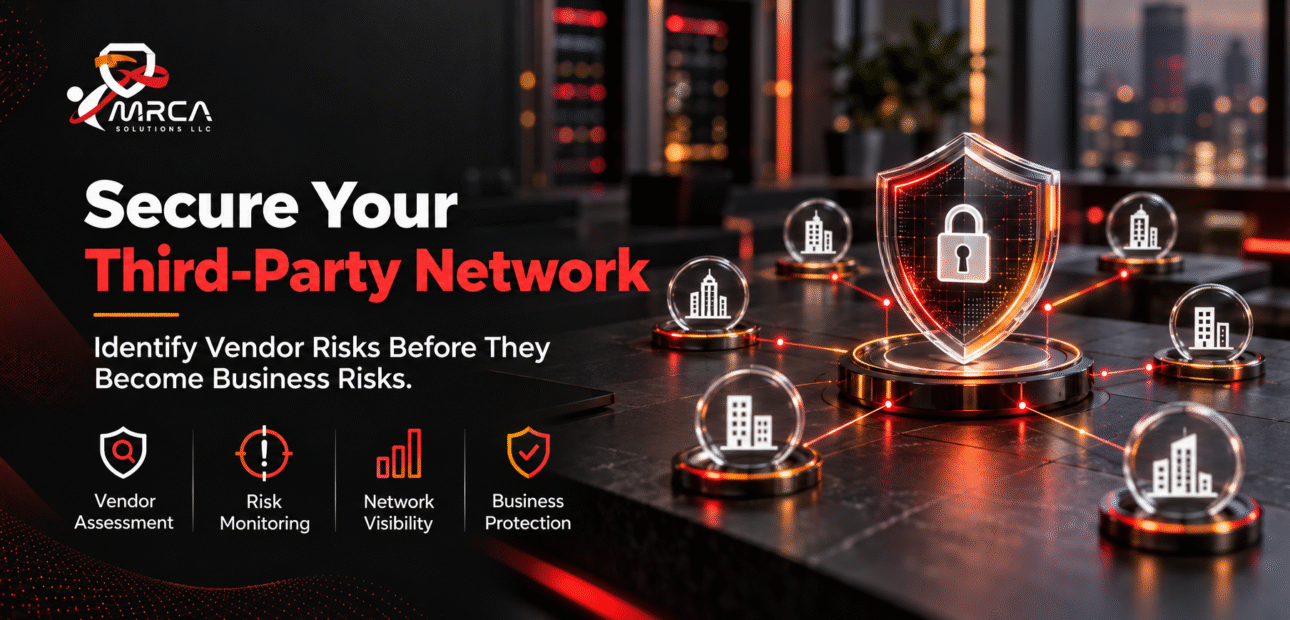
Businesses increasingly rely on vendors, contractors, technology providers, cloud platforms, and other third parties to support their operations. While these relationships can improve efficiency and provide access to specialized services, they can also introduce cybersecurity risks.
A third party may have access to sensitive information, business systems, networks, or customer data. If that organization has weak security controls, a cyber incident involving the vendor could also affect your business.
Managing third-party cybersecurity risk requires more than evaluating a vendor when the relationship begins. Organizations need a structured process for assessing, monitoring, and addressing vendor-related security risks throughout the relationship.
What Is Third-Party Cybersecurity Risk?
Third-party cybersecurity risk is the potential for a vendor, contractor, service provider, or business partner to introduce security vulnerabilities or contribute to a cybersecurity incident affecting your organization.
Examples include:
Unauthorized access to company systems
Exposure of sensitive customer or business information
Weak vendor security controls
Compromised third-party software
Inadequate access management
Data stored or processed by external providers
Security incidents involving vendors
Poor incident reporting or response procedures
The risk can increase when a third party has extensive access to critical systems or sensitive information.
Why Third-Party Cybersecurity Risk Matters
Organizations can have strong internal security controls while still being exposed through external relationships.
For example, a vendor with access to company credentials or customer information could become an entry point for attackers. Similarly, a cloud or technology provider experiencing a security incident could affect business operations even if the organization’s internal systems remain secure.
Effective third-party risk management can help organizations:
Identify vendor-related vulnerabilities
Protect sensitive information
Strengthen access controls
Improve vendor accountability
Support regulatory and compliance requirements
Reduce exposure to supply-chain attacks
Improve incident preparedness
Protect business continuity
Common Third-Party Cybersecurity Risks
1. Excessive System Access
Vendors may receive access to systems they do not actually need. Excessive permissions can increase the potential impact of a compromised vendor account.
Organizations should follow the principle of least privilege and provide only the access necessary for a vendor to perform its responsibilities.
2. Weak Vendor Security Controls
Not every vendor maintains the same level of cybersecurity maturity. Weak passwords, outdated systems, insufficient monitoring, or poor security policies can create additional exposure.
Before establishing important vendor relationships, organizations should understand whether the vendor has appropriate security controls in place.
3. Sensitive Data Exposure
Third parties may collect, store, process, or transmit sensitive information on behalf of an organization.
Businesses should understand:
What information the vendor receives
Where the information is stored
Who can access it
How it is protected
How long it is retained
What happens when the relationship ends
4. Lack of Security Requirements in Contracts
Vendor agreements should clearly establish cybersecurity responsibilities.
Depending on the relationship, contracts may address data protection, security standards, breach notification, access controls, confidentiality, audit rights, and requirements for returning or destroying information.
5. Limited Ongoing Monitoring
Vendor risk can change after a contract is signed. Vendors may introduce new systems, subcontract work, experience security incidents, or change how information is handled.
For higher-risk vendors, organizations should consider ongoing monitoring rather than relying solely on an initial assessment.
How to Manage Third-Party Cybersecurity Risk
1. Identify Your Third Parties
Start by creating an inventory of vendors and service providers that interact with your systems, data, or business operations.
Not every vendor presents the same level of risk, so organizations should understand which relationships are most important.
2. Classify Vendors Based on Risk
A risk-based classification can consider factors such as:
Access to sensitive data
Access to critical systems
Business dependency
Regulatory requirements
Service criticality
Geographic considerations
Security maturity
High-risk vendors may require more detailed assessments and frequent monitoring.
3. Perform Vendor Security Assessments
Before onboarding a high-risk vendor, organizations can evaluate its security practices, policies, controls, certifications, incident history, and approach to protecting information.
The assessment should be appropriate to the nature and level of risk.
4. Establish Security Requirements
Cybersecurity expectations should be clearly communicated to vendors and incorporated into agreements where appropriate.
Requirements may address data protection, access management, security incident notification, vulnerability management, employee security practices, and other relevant controls.
5. Monitor Vendor Risk
Third-party risk management should continue throughout the vendor relationship.
Periodic reviews can help determine whether security controls remain appropriate and whether significant changes have occurred.
6. Prepare for Vendor Security Incidents
Organizations should understand what happens if a critical vendor experiences a cyber incident.
Incident response plans should identify:
Who must be notified
How quickly notification should occur
What information should be provided
Who is responsible for communication
How business operations will be maintained
What remediation steps are expected
Preparing in advance can reduce confusion during an actual incident.
Questions Businesses Should Ask Their Vendors
Organizations evaluating important vendors may consider questions such as:
What cybersecurity policies and controls are in place?
How is sensitive information protected?
Who has access to our data?
How is access reviewed and removed?
Has the vendor experienced a significant security incident?
How are cybersecurity incidents reported?
Does the vendor use subcontractors?
How is subcontractor risk managed?
What happens to our data when the contract ends?
The specific questions should reflect the organization’s risk profile and the services being provided.
How MRCA Solutions Helps
MRCA Solutions can help organizations evaluate and manage cybersecurity risks associated with vendors and third parties.
Our consulting approach can support vendor risk assessments, cybersecurity reviews, risk identification, control evaluation, and recommendations for strengthening third-party risk management processes.
By combining cybersecurity, internal audit, governance, risk, and compliance experience, MRCA Solutions can help organizations develop a more comprehensive view of third-party risk.
Frequently Asked Questions (FAQs)
1. What is third-party cybersecurity risk?
Third-party cybersecurity risk is the potential security exposure created by vendors, contractors, technology providers, and other external organizations that interact with a business's systems, data, or operations.
2. Why are vendors a cybersecurity concern?
Vendors may have access to sensitive information, systems, or networks. If their security controls are inadequate or their systems are compromised, the incident may affect the organization they serve.
3. Should every vendor receive the same level of cybersecurity assessment?
No. A risk-based approach allows organizations to apply greater scrutiny to vendors with access to sensitive information, critical systems, or essential business operations.
4. How often should vendor cybersecurity risk be reviewed?
The appropriate frequency depends on the vendor's risk level, services, access, regulatory requirements, and changes to the relationship. Higher-risk vendors may require more frequent reviews.
5. What should a vendor cybersecurity assessment include?
Depending on the relationship, an assessment may review security policies, access controls, data protection, incident response, vulnerability management, security certifications, subcontractors, and other relevant controls.
6. Can third-party cybersecurity risk be completely eliminated?
No. The objective is to identify, evaluate, and manage third-party risks to an acceptable level through appropriate controls, contractual requirements, monitoring, and incident preparedness.