
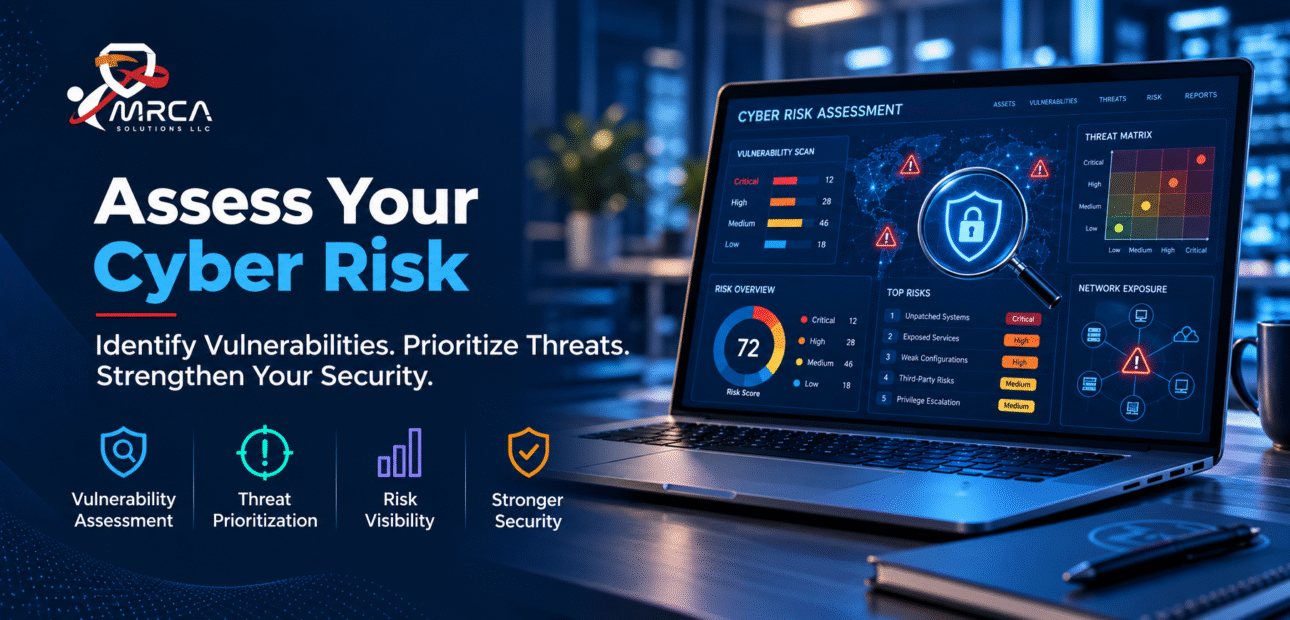
Cybersecurity risks can affect every part of a business, from customer information and financial data to critical systems and daily operations. A cybersecurity risk assessment helps organizations identify potential threats, understand vulnerabilities, and determine which risks require immediate attention.
Rather than waiting for a cyber incident to expose weaknesses, businesses can use a structured risk assessment to take a proactive approach to security. It provides leadership with a clearer understanding of the organization’s cyber risk and helps guide security investments and priorities.
What Is a Cybersecurity Risk Assessment?
A cybersecurity risk assessment is a structured process used to identify, evaluate, and prioritize risks to an organization’s information systems, data, applications, networks, and business operations.
An effective assessment considers three key areas:
Threats — What could potentially cause harm?
Vulnerabilities — Where are weaknesses that could be exploited?
Business impact — What would happen if a particular risk occurred?
The goal is not simply to identify every possible cybersecurity threat. It is to understand which risks could have the greatest impact on the organization and determine how they should be addressed.
Why Cybersecurity Risk Assessments Matter
Cybersecurity threats continue to evolve, and organizations may have vulnerabilities they are unaware of. A risk assessment provides a structured way to identify these weaknesses before they result in significant damage.
Key benefits include:
Identifying vulnerabilities in systems and processes
Prioritizing the organization’s most significant cyber risks
Protecting sensitive business and customer information
Supporting regulatory and compliance requirements
Improving cybersecurity planning and decision-making
Helping leadership allocate security resources effectively
Strengthening overall business resilience
Key Steps in an Effective Cybersecurity Risk Assessment
1. Identify Critical Assets and Information
Begin by determining what needs to be protected. This may include:
Customer and employee information
Financial records
Intellectual property
Business applications
IT infrastructure
Cloud environments
Databases
Operational systems
Understanding which assets are most important helps establish appropriate security priorities.
2. Identify Potential Cybersecurity Threats
Next, consider the threats that could affect the organization’s assets. These may include:
Phishing and social engineering
Ransomware
Malware
Credential theft
Insider threats
Business email compromise
Unauthorized access
Third-party security risks
Data theft
Threat identification should consider both external and internal sources of risk.
3. Identify Vulnerabilities
Organizations should determine where weaknesses exist within their technology, people, and processes.
Examples may include outdated software, weak passwords, excessive user permissions, inadequate security controls, poor employee awareness, or insufficient monitoring.
Cybersecurity assessments should also consider vulnerabilities associated with vendors, cloud services, and other third parties.
4. Evaluate Likelihood and Business Impact
Not every cybersecurity risk has the same level of importance. Each identified risk should be evaluated based on factors such as:
Likelihood of occurrence
Potential financial impact
Operational disruption
Regulatory consequences
Reputational damage
Impact on customers or stakeholders
This allows organizations to distinguish between lower-priority issues and risks requiring immediate action.
5. Prioritize Cybersecurity Risks
Once risks have been evaluated, they should be ranked according to their potential impact and likelihood.
High-priority risks may require immediate remediation, while lower-priority issues can be addressed through longer-term improvement plans.
A risk-based approach helps organizations focus limited cybersecurity resources where they can provide the greatest value.
6. Develop a Risk Treatment Plan
The assessment should result in practical recommendations. Depending on the risk, an organization may choose to:
Reduce the risk through additional security controls
Transfer certain risks through insurance or contractual arrangements
Avoid activities that create unacceptable risk
Accept risks that fall within established tolerance levels
Each action should have clear ownership and reasonable timelines.
7. Review and Update the Assessment
Cybersecurity risk assessments should not be treated as a one-time exercise. New technologies, employees, vendors, regulations, and threats can change an organization’s risk profile.
Regular reviews help ensure that cybersecurity strategies continue to reflect the organization’s current environment.
Common Cybersecurity Risk Assessment Mistakes
Businesses can weaken the effectiveness of their assessments by:
Focusing only on technical vulnerabilities
Ignoring employee and process-related risks
Failing to assess third-party risks
Treating all risks as equally important
Not assigning responsibility for remediation
Conducting assessments without meaningful follow-up
Failing to communicate significant risks to leadership
An effective assessment should connect cybersecurity findings to actual business risks and decisions.
How MRCA Solutions Helps
MRCA Solutions provides cybersecurity consulting support designed to help organizations better understand and manage their cyber risk. Our approach can help identify vulnerabilities, evaluate potential business impacts, prioritize risks, and develop practical recommendations.
By combining cybersecurity expertise with experience in internal audit, governance, risk, and compliance, MRCA Solutions can help organizations look at cybersecurity from both a technical and business perspective.
Frequently Asked Questions (FAQs)
1. What is the main purpose of a cybersecurity risk assessment?
The primary purpose is to identify cybersecurity threats and vulnerabilities, evaluate their potential impact, and prioritize actions to reduce significant risks.
2. How often should a cybersecurity risk assessment be performed?
The appropriate frequency depends on the organization, its risk profile, regulatory requirements, and changes to its technology environment. Assessments should also be reconsidered after major changes or significant security incidents.
3. Does a cybersecurity risk assessment only focus on IT systems?
No. An effective assessment considers technology, people, processes, third parties, data, and business operations.
4. What is the difference between a vulnerability assessment and a cybersecurity risk assessment?
A vulnerability assessment primarily identifies technical weaknesses. A cybersecurity risk assessment takes a broader view by considering threats, vulnerabilities, likelihood, and potential business impact.
5. Can small businesses benefit from cybersecurity risk assessments?
Yes. Smaller organizations can also face significant cyber risks. A risk assessment can help them focus limited resources on their most important vulnerabilities and security priorities.
6. How can cybersecurity risk assessment findings be used?
The findings can support security improvements, risk management decisions, compliance efforts, budgeting, incident preparedness, and broader business continuity planning.
Conclusion
Cybersecurity risk assessments give organizations a practical way to understand where they are most vulnerable and where security improvements should be prioritized. By identifying critical assets, evaluating threats and vulnerabilities, and connecting cyber risks to business impact, organizations can make more informed security decisions.
A proactive assessment can help businesses strengthen controls, reduce exposure, and improve their ability to respond to evolving cybersecurity threats.