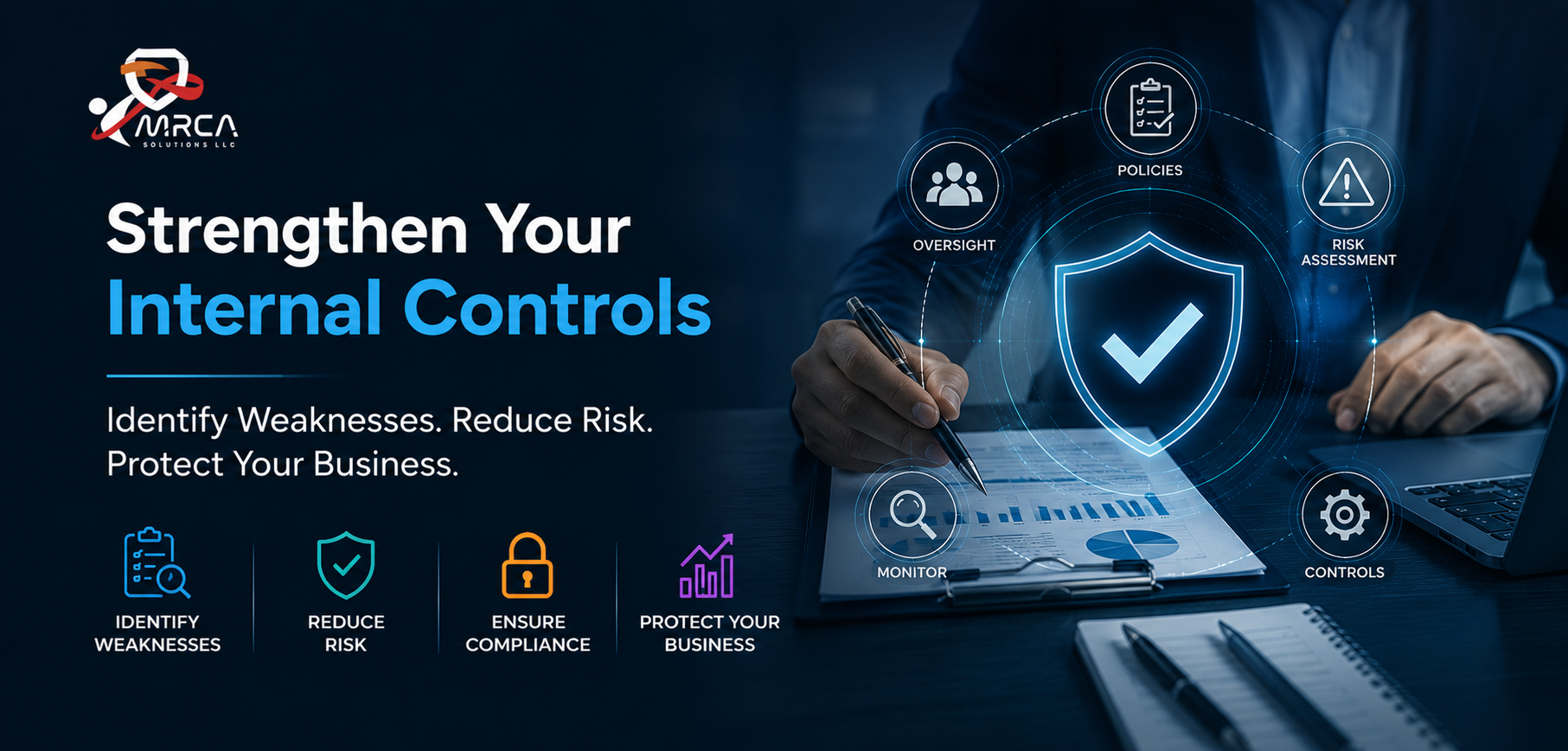
Strong internal controls help businesses protect assets, reduce fraud, maintain accurate records, support compliance, and improve operational efficiency. However, as organizations grow, their controls can become outdated or ineffective.
Identifying weaknesses early allows businesses to address risks before they lead to financial losses, compliance issues, or operational disruptions.
At MRCA Solutions LLC, we help organizations evaluate internal controls, identify risks, and implement practical improvements that strengthen governance and business performance.
What Are Internal Controls?
Internal controls are the policies, procedures, and safeguards organizations use to manage risk and support business objectives.
Effective controls help businesses:
Protect assets and sensitive information
Reduce fraud and errors
Improve accountability
Support regulatory compliance
Strengthen operational efficiency
Common Internal Control Weaknesses
1. Lack of Segregation of Duties
When one employee controls multiple stages of a financial or operational process, the risk of fraud and errors increases. Separating responsibilities helps create stronger oversight.
2. Weak Access Controls
Employees should only have access to the systems and information necessary for their roles. Shared passwords, excessive privileges, and inactive user accounts can create unnecessary security risks.
3. Inadequate Approval Processes
Transactions, expenses, purchases, and contracts should have clearly defined approval requirements. Weak approval controls can lead to unauthorized spending and financial losses.
4. Poor Documentation
Missing policies, approvals, transaction records, and audit trails make it difficult to demonstrate compliance or investigate problems.
5. Inadequate Reconciliations
Regular bank, vendor, inventory, and account reconciliations help identify errors, discrepancies, and unauthorized transactions before they become larger issues.
6. Weak Vendor Controls
Third-party relationships can introduce financial, operational, and cybersecurity risks. Businesses should conduct appropriate vendor due diligence and regularly review vendor performance and access.
7. Outdated Policies and Procedures
Business processes change over time. Policies should be reviewed periodically to ensure they reflect current operations, technologies, and regulatory requirements.
8. Insufficient Monitoring
Controls must be monitored to ensure they are working as intended. Internal audits, management reviews, risk assessments, and control testing can help identify weaknesses early.
9. Lack of Employee Awareness
Employees need to understand company policies, approval requirements, cybersecurity practices, and reporting procedures. Proper training helps make internal controls more effective.
How Internal Audit Helps
Internal audit provides an independent assessment of an organization’s control environment. Reviews may cover financial processes, operations, IT systems, compliance, vendor management, and fraud risks.
The goal is not simply to identify problems but to provide practical recommendations that help management strengthen controls and reduce risk.
How MRCA Solutions Helps
At MRCA Solutions LLC, we provide risk-focused Internal Audit Services to help organizations:
Evaluate internal controls
Identify control gaps
Assess fraud and operational risks
Review financial and business processes
Strengthen governance and accountability
Develop actionable recommendations
With more than 30 years of hands-on experience in internal audit, cybersecurity, governance, risk, and compliance, MRCA Solutions brings a comprehensive perspective to internal control assessments.
Frequently Asked Questions (FAQs)
1. What is an internal control weakness?
An internal control weakness occurs when a policy, process, or safeguard is missing, poorly designed, or not operating effectively.
2. What are common internal control weaknesses?
Common examples include weak segregation of duties, poor access controls, inadequate approvals, outdated policies, insufficient monitoring, and weak vendor controls.
3. How often should internal controls be reviewed?
The frequency depends on the organization's size, industry, and risk profile. Higher-risk areas may require more frequent reviews.
4. Can internal controls prevent fraud?
No control system can eliminate fraud completely, but strong controls can significantly reduce opportunities for fraud and improve early detection.
5. Why is segregation of duties important?
It prevents one individual from having excessive control over multiple stages of a transaction, reducing the risk of unauthorized activity and errors.
6. How can MRCA Solutions help?
MRCA Solutions can conduct internal audits, risk assessments, and control evaluations to identify weaknesses and provide practical recommendations for improvement.